
How do you react to the news these days? I don’t know about you, but I find it hard to read, with Trump throwing his weight around and breaking things, and the international community huffing and puffing while Netanyahu blows down the houses,… and tents,… and hospitals.
The Palestinian poet Mosab Abu Toha won the Pulitzer Prize for Commentary in May this year. [His poem A Litany for “One Land” is reproduced below]. When he was notified of his Pulitzer Prize win, he posted on social media, “Let it bring hope. Let it be a tale”. The comment appears to be a tribute to his fellow Palestinian poet Refaat Alareer, who was killed in an Israeli attack in Gaza in December 2023. Alareer’s final poem was titled, “If I must die, let it be a tale” [Ref. Al Jazeera 5/5/2025]. But where do we find hope these days?
Our Small Group has recently been working through Brian McLaren’s book, “Everything must change: Jesus, Global Crises and a Revolution of Hope”. McLaren suggests that when we have no hope, we lose sight of a better future, we may lose creativity and the will to organise. He imagines “Jesus… walking among his own oppressed and dominated people, people who…had lost their hope. Their hopelessness left them paralyzed and powerless between two primary schemes of despair—the violent despair of terrorist resistance or the resigned despair of capitulation and collaboration with their powerful oppressors.” What Jesus brought was a message of hope: “another world is possible”. What was needed was a “revolution of hope”; a revolution that requires us to learn “the skills of a new way of seeing, the habits of a new way of thinking, the capacities of a new way of living.”
And yet, although the message was radical, it was not new. It is a message that recurs throughout the Hebrew bible as well as the Christian writings, spoken by the prophets again and again. And the Christian church has been no quicker on the uptake. It is as Mosab Abu Toha writes at the end of his poem, “We have been speaking but you never cared to listen”
Today’s readings give us the opportunity to look at that message both from a Hebrew prophet and from Jesus (or perhaps I should just say, from two Hebrew prophets?). Let’s consider Jeremiah first. When the prophet Jeremiah’s words were spoken, around 2600 years ago, his tiny nation state of Judah was under threat and by the time his words were written down much of his homeland was destroyed and many of his people were in exile.
In Jeremiah’s time, the rise and fall of nations’ fortunes was seen as linked to the influence of the gods. In Jewish terms, linked to the Israelites’ faithfulness and faithlessness to Yahweh, their God, and in their eyes the only true god. The poetry of chapters 2-6, from which we heard today, is dense and repetitive. In strongly patriarchal language, Jeremiah portrays Judah as a wayward and thankless child who has rejected their father, a faithless wife who has prostituted herself with other men; and he portrays a God who in response will bring other nations against Judah in punishment.
It is not our language; it is not our world. It is the language of a Bronze Age tribal culture when the Israelites, as an identifiable grouping, were relatively new kids on the block. Worship of the old gods such as Baal and various forms of Asherah originated in the Canaanite and Phoenician city states 2000 years before Moses or King David. As the three main powers, Egypt, Assyria and Babylon periodically swept through the region, allegiances and peoples shifted and it was hard to hang on to cultural and religious identity; but covenants were at the core of tribal behaviour – covenants between individuals, between tribes, covenants with leaders, covenants with gods.
Jeremiah grew up in a priestly family during a resurgent period of Judah’s history. After dominating the region for about 250 years the Assyrian hold on its overstretched empire had begun to weaken. King Josiah of Judah gained a degree of freedom, refurbished Solomon’s Temple and reinstituted Jewish laws. The story in 2 Kings 22:8 is that he “rediscovered” the book of the law, but it may actually be describing the first time the Deuteronomic laws were written down. Jeremiah appears to have been supportive of King Josiah’s reforms.
At what is portrayed to be the start of his prophetic period, Jeremiah warned the Kings of Judah that regional power struggles would bring misfortune (Jer 1:13) – there was a “bubbling cauldron” to the north, ready to tip its contents southwards. Jeremiah’s descriptions of the world which would result from the wars between great powers is as meaningful today as then: “I looked, and there was no one at all, and all the birds of the air had fled. I looked, and the fruitful land was a desert, and all its cities were laid in ruins”. (v25-26)
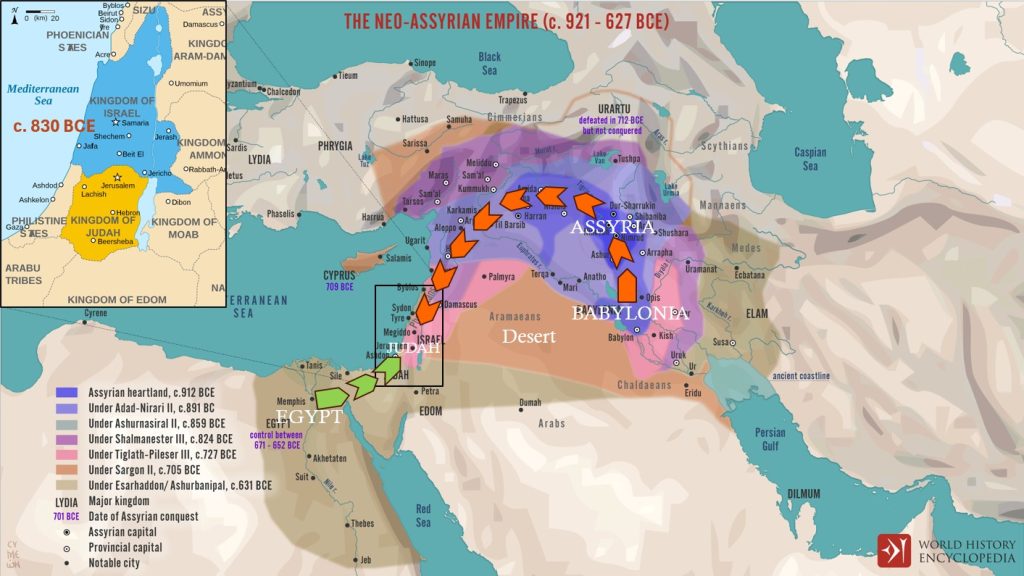 As Assyria’s power waned, Babylonia took advantage of Assyria’s weakness. In a coalition with other tribes, the Babylonians destroyed the Assyrian cities, occupied Syria and threatened Judah from the north. Egypt moved northwards to counter their advance, and little Judah, caught in the middle, had to decide which way to jump.
For reasons no-one understands, Josiah jumped the wrong way. He went out to battle against his erstwhile allies, the Egyptians, and was killed. The Egyptians placed one of Josiah’s sons, Jehoiakim, on the throne providing that he paid a tribute to Egypt. As described in 2Kings 23:35-37, Jehoiakim “exacted the gold and silver from the people of the land” and “did what was evil in the sight of the LORD”. At this point Jeremiah’s criticism of Jehoiakim makes it clear that his support for Josiah’s reforms was support for the programme of social justice that was embedded in the law.
Jeremiah’s poetry in Chapter 22 uses plain language (22:13, 15-17): “Woe to him who builds his house by unrighteousness and his upper rooms by injustice, who makes his neighbours work for nothing and does not give them their wages… Did not your father [that is, King Josiah] eat and drink and do justice and righteousness? Then it was well with him. He judged the cause of the poor and needy; then it was well… But your eyes and heart are only on your dishonest gain, for shedding innocent blood, and for practicing oppression and violence.”
Jeremiah saw injustice, oppression and destruction of the land as directly linked to abandoning their God. How were they linked? Because the Deuteronomic laws that had been developed in response to the Israelites’ covenant with God defined frameworks of social justice, protecting the land and the people. In Chapter 7, Jeremiah’s warnings are written in prose rather than poetry:
“Do not trust in these deceptive words: “This is the temple of the LORD, the temple of the LORD, the temple of the LORD. For if you truly amend your ways and your doings, if you truly act justly one with another, if you do not oppress the alien, the orphan, and the widow or shed innocent blood in this place, and if you do not go after other gods to your own hurt, then I will dwell with you in this place, in the land that I gave to your ancestors forever and ever.” (7:4-7)
Jeremiah says that worship in the Temple is meaningless if the people do not live by the covenant in their behaviour. It is as meaningless, in Jeremiah’s terms, as the worship of foreign gods. King Josiah started his reform by making a covenant in front of all the people to follow the laws, and all the people joined in the covenant (2 Kings 22-23). But, as we can see from Jeremiah’s words, the covenant did not survive the king’s death.
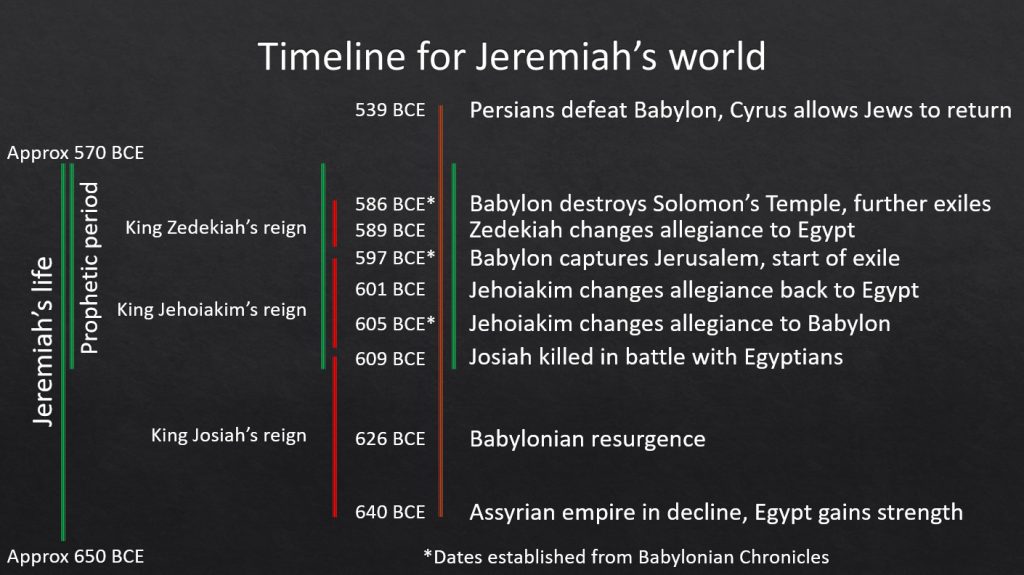 Jeremiah also warned against playing politics between powerful neighbours, currying favour without principles, cosying up to first one and then another, seeking to follow where the wind blows. But after four years under Egypt’s protection (control?), the Babylonians came knocking on the door and Jehoiakim was forced to pay tribute to Babylon. Three years later, he saw an opportunity for liberation when the Egyptians successfully repelled a Babylonian incursion. The Egyptian success was short-lived and the Babylonians swept back in revenge, overwhelmed Judah, captured Jehoiakim and installed their choice of client king, Zedekiah. They returned to Babylon, taking with them a massive tribute in both gold and people. A similar story followed as Zedekiah changed sides, which ended with the utter destruction of Solomon’s Temple and much of the city of Jerusalem, and the exile of its remaining inhabitants to Babylon. There, they sat down and wept.
Let’s fast forward about 600 years to Jesus’ time. The world order had changed again several times during the intervening period. The Babylonians had been and gone, as had the Persian Empire and the Macedonian Empire of Alexander the Great. Judea remained caught between super-powers, sometimes benign, sometimes not. From 167 BCE for around 100 years the Maccabees had attained some degree of Judean independence, but at the price of continued fighting with neighbouring powers and a vicious civil war which was ended by the violent intervention of the Romans in 63 BCE. Pax Romana had arrived in the region and by Jesus’ birth Rome had controlled Judea for some 60 years, appointing a series of local “client kings”. But while Rome had control of Judea militarily, politically and economically, they did not have full control ideologically. Around the time Jesus was born, King Herod the Great’s death was followed by a series of uprisings throughout Judea, including at Sepphoris, just a few kilometres from his birth town. If Jesus’ parents had to flee to Egypt after his birth as the gospel of Matthew suggests, it wouldn’t have been from a paranoid King Herod but from a vengeful Roman Governor Varus. Another period of relative stability under strong leaders had come to an end. About ten years later, one of Herod the Great’s sons, Archelaus, was so unpopular and (more importantly to the Romans) so incompetent, that Judea was placed under direct Roman rule.
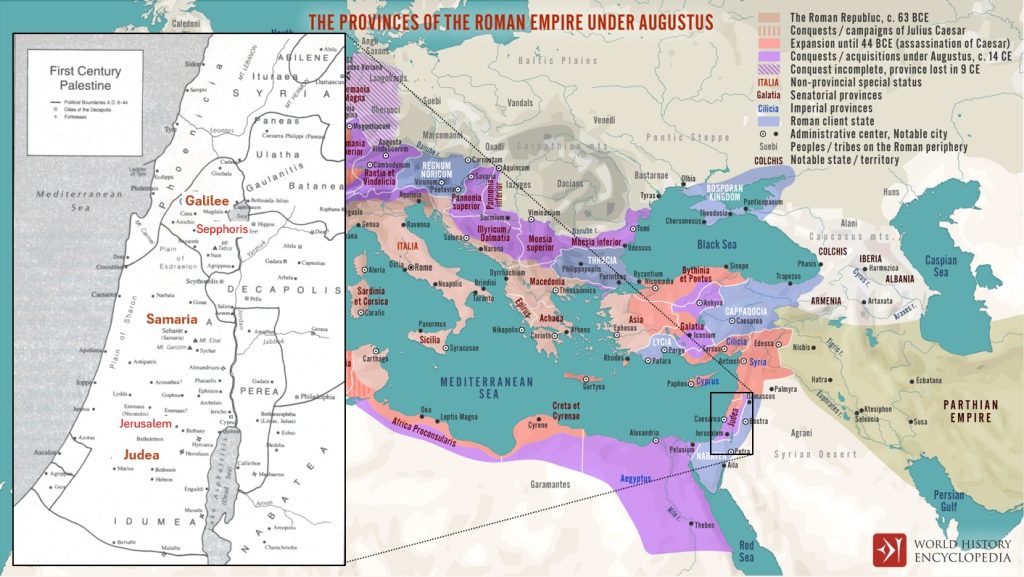
Was the political situation similar to Jeremiah’s time? Jesus’ people were not facing exile but they were certainly not free. The economic structure of the Roman Empire was based on slave labour and directing wealth generated by the impoverished many to the wealthy elite. The ordinary people suffered for their leaders’ excesses, just as they had under Jehoiakim. Herod’s rebuilding of the Temple in Jerusalem renewed the Jewish temple cult but was built using taxes. It is no wonder that tax collectors were social outcasts, or that the wealthy come in for criticism in the gospels.
First Century Jews had to negotiate their way between opposition and collaboration. Overt opposition was asking for trouble from the authorities; but working too closely with the system could make you unpopular with your own community, and with good reason. One way in which the occupying culture worked was through patronage – having friends in high places, or at least higher than your own place, provided opportunities for business or social advancement. Patrons were powerful individuals who controlled resources and gained honour by handing out favours to large trains of client dependents. Clients received these favours and in return owed loyalty to and performed menial duties for their patron. Richard Rohrbaugh, Professor Emeritus of Religious Studies at Lewis and Clark College in Portland, Oregon writes, “as patronage spread to provinces such as Syria (Palestine)… the newly rich, seeking to aggrandize family position in a community, competed to add dependents. Formal, mutual obligations degenerated into petty favour-seeking and manipulation.” Our reading from Luke’s gospel today needs to be seen in this context.
The phrase about inverting the status of those who humble themselves and those who exalt themselves (v 10-11) occurs several times in the gospels. Matthew and Luke both attach it to criticism of the Pharisees. Although the message was radical, it was not new – the theme of God humbling the proud and exalting the humble is common in Hebrew wisdom (eg Prov 11:2, Ps 18:27). But in this example, Luke uses the proverb to amplify Jesus’ criticism of the unjust Roman social system in which patronage enabled a scramble for personal wealth and influence (v 7-9).
Oddly, the second story in our reading sounds instead more like an exhortation to the traditional Roman purpose of patronage – gaining honour by bestowing favours to those less fortunate. The Jesus Seminar agreed that it represents a Lukan insertion, linking to the previous and following parables, but actually distorting the original critical comments.
The third part of Luke’s compilation, which we did not read today, is the well-known parable of the host whose dinner guests decline to attend at the last minute for various curious reasons – “just bought a piece of land”, “five yoke of oxen”, “just married”. The Jesus Seminar viewed this parable as characteristic of Jesus’ provocative style of speaking. It is succinct, makes fun of the practice of patronage, and has a surprising ending. The host becomes angry and is forced to save face by filling his hall with anyone his servants can find, compelling them to his patronage by force if necessary. It is a parable, a metaphor within a story, which challenges the listener to think again about the social structures of the day, about what is just and unjust in the world around us. It is left to the listener to decide how to respond to the challenge.
This idea of Jesus as challenger, rather than solution-finder is raised in the book from Brian McLaren’s that I mentioned earlier. McLaren writes that Jesus “challenged people to believe that there could be a better, more human, more satisfying alternative to the … economic laws of the Roman empire.”
Jeremiah said to his kings, don’t join in the game of thrones. Stick to the covenant, do what is just, do not oppress the vulnerable, do not shed innocent blood. Jesus said to the ordinary people of Galilee and Judea, don’t join in the game of empires. Stick to the covenant, work together, do what is just, look after one another.
Empires have come and gone: the Egyptians, Assyrians, Babylonians, Persians, Macedonians, Romans, Mongols, Mughals and British. All imposed by violence and empowered by wealth extraction. But the game is still played by the world’s major powers. Those who want to impose their will; those who want to extract as much wealth for themselves as they can.
And in the long run the result is the same. You can’t impose peace by killing as many of your enemies as possible. You can’t buy peace by imposing economic deals on your trading partners. If you are wealthy, the best way to protect yourself is not to build walls and hire security guards; it is to ensure that those around you have a quality of life that means they will not need to take by force. If you are poor, you will not gain security by pitting yourself against your neighbour but by joining forces with them to demand a better deal.
Tomorrow (1st September) is Labor Day in the US. Vanderbilt Divinity School recently marked the occasion with a webinar considering how religion can be a force for good in the fight for economic and political justice rather than a supporter of current systems driven by greed and individualism. Rev Dr Cassandra Gould spoke passionately about the need for churches to be not a shelter from the world but places where people of faith turn up and organise to show solidarity with and protect people facing persecution and injustice. As, for example, those who organise their neighbourhoods to protect refugees from the ICE squads in the US or from the far-right nationalists in the UK. Rev Dr Aaron Stauffer, another contributor to the meeting, said organising is central to the church: without that, it becomes more like a hobby and a charity. Faith calls us into relationship with one another, to action not to belief.
Why do we work for justice? Because it is right and because justice brings peace. The Hebrew word, shalom, which is usually translated as “peace”, is derived from a root denoting wholeness or completeness and bound up with the notion of shelemut, perfection. Periods of rapid political and social change in can often be traced back to earlier unresolved problems, which were too small or too far away for us to take notice of, which did not appear to affect us directly, or which grew so gradually we did not notice the change. Wars and droughts leading to mass migration. Unjust resolutions of earlier conflicts leading to simmering resentment. Population growth placing ever increasing pressure on finite resources which are unfairly distributed. A lack of justice.
McLaren’s description of the alternative that Jesus presents can be summarised in four parts. To work for the common good instead of individual advancement; to find satisfaction through gratitude and sharing rather than possession and consumption; to seek justice rather than to compete for power and wealth; to show love for others instead of fearing them.
Given the state of the world as we see it, is this an unrealistic aspiration, a futile hope? The former president of the Czech Republic wrote that hope is “a state of mind, not a state of the world… Hope… is not the same as… willingness to invest in enterprises that are obviously headed for early success, but rather an ability to work for something because it is good, not just because it stands a chance to succeed”. McLaren writes, “If we don’t believe Jesus’ message, then we won’t even seek for better alternatives and so of course we won’t work out the details. If we do, what seems impossible may … prove possible.”
We, as a church need to remember this when we stand up against injustice. We should not be afraid of being unpopular (particularly with the authorities and representatives of the status quo) when standing up for social justice. When David Seymour hit out at church leaders, including our own MCNZ, over the Treaty Principles Bill in September last year, when he hit out at churches, including MCNZ, organising workshops on retaining Māori wards, you know we are doing something right!
We do this work not because it will succeed – although it may – but because it is good, because it must be done to bring into being a better alternative to the current system. And if we get on with the work needed, what seems impossible may become possible. And therein lies our hope.
A LITANY FOR “ONE LAND” (After Audre Lorde)
– by Mosab Abu Toha.
For those living on the other side,
we can see you, we can see the rain
when it pours on your (our) fields, on your (our) valleys,
and when it slides down the roofs of your “modern” houses
(built atop our homes).
Can you take off your sunglasses and look at us here,
see how the rain has flooded our streets,
how the children’s umbrellas have been pierced
by a prickly downpour on their way to school?
The trees you see have been watered with our tears.
They bear no fruit.
The red roses take their color from our blood.
They smell of death.
The river that separates us from you is just
a mirage you created when you expelled us.
IT IS ONE LAND!
For those who are standing on the other side
shooting at us, spitting on us,
how long can you stand there, fenced by hate?
Are you going to keep your black glasses on until
you’re unable to put them down?
Soon we won’t be here for you to watch.
It won’t matter if you blink your eyes or not,
if you can stand or not.
You won’t cross that river
to take more lands,
because you will vanish into your mirage.
You can’t build a colony on our graves.
And when we die,
our bones will continue to grow,
to reach and intertwine with the roots of the olive
and orange trees, to bathe in the sweet Yaffa sea.
One day, we will be born again when you’re not there.
Because this land knows us. She is our mother.
When we die, we’re just resting in her womb
until the darkness is cleared.
For those who are NOT here anymore,
We have been here forever.
We have been speaking but you
never cared to listen.