
“But the Samaritans did not welcome him, because he had made up his mind to go on to Jerusalem. When his disciples James and John realised this, they said, “Lord, do you want us to call down fire from heaven and annihilate them?” Today’s passage from the gospel of Luke speaks to us so strongly at the moment, when the disciples of Netanyahu or Trump are literally able to call down fire from the sky to consume their enemies.
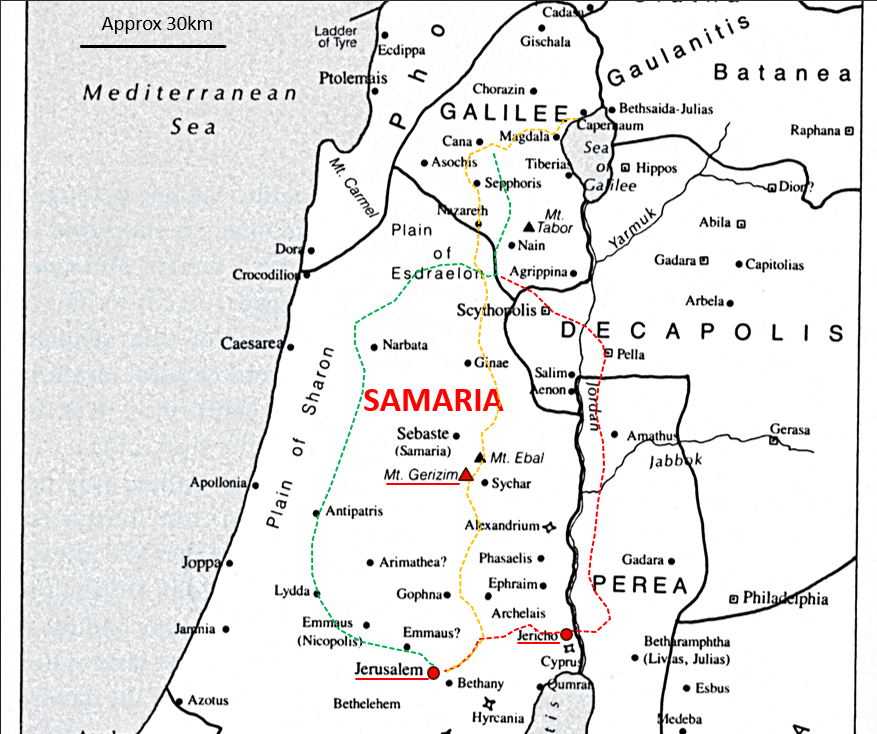
Samaria was a hill country between Galilee and Judea. There were alternative routes for Jesus and those on pilgrimage to Jerusalem to take but Samaria was the most direct. The problem with this route was that Samaritans and Jews had been at odds for centuries. As Dominic Crossan describes it, the relationship “was an estrangement between descendants of the same ancestors … which had hardened into ethnic, political and religious animosity” *1. At the core of the hostility were views of racial purity and arguments over where the Temple should be located – Mount Gerazim or Jerusalem. About 150 years before Jesus’s visit, the Judean King, John Hercanus, on a campaign of territorial expansion, conquered Samaria and destroyed the Samaritan Temple. About 20 years after Jesus passed through, there was such violence between Samaritans and pilgrims from Galilee that the Roman governor of Syria sent troops to intervene! How great that enmity must have been for Luke to suggest the disciples said, “Lord, do you want us to call down fire from heaven and annihilate them?”!
But Jesus “turned and reprimanded them” (“turned and rebuked them”, in another translation). How different it seems today! “Do you want us to call down fire from heaven and annihilate them?” Yes! Call in the attack helicopters and fighter bombers; launch cruise missiles and fire artillery; send in drones to drop grenades silently from the sky; drop bunker busters from stealth bombers.
“But he turned and rebuked them”. Not, “we love you God and we love our great military”. Not, “we love our zealot freedom fighters and their opposition to Roman occupation”; not “we love the sicarii and their assassinations of Romans and sympathisers in Jerusalem”, but “he turned and rebuked them”.
Yes, the passage resonates strongly today. Let’s have a closer look at a few details. Luke mentions Samaritans only four times in his gospel. This reading is the first occasion; the next two occurrences are in the Parable of the Good Samaritan (in the following chapter). Neither today’s story nor the parable of the Samaritan occur any of the other gospels – they are uniquely Lukan. Sandwiched between these two references is Luke’s description of Jesus sending out seventy-two (or seventy in many manuscripts) on a mission ahead of him. This mission is an expanded version of the sending out of the twelve disciples in Mark, using extensive material from the Q source (material found also in Matthew). Intriguingly, Matthew’s version has Jesus specifically tell the disciples not to go to Samaritan cities, but only “to the lost sheep of Israel”. There is no such injunction in Luke’s version, and I suggest that the entire sequence from today’s reading through to the parable is a careful literary construction, providing the back-story for the parable and framing the mission story with evidence of the universality of Jesus’ message.
The title, “Parable of the Good Samaritan” is not in the original Greek text and was probably added around the time of the King James translation. As we all know, Luke’s gospel has Jesus tell the parable in response to a question from an expert in Jewish law, “who is my neighbour?” (v10:29). The definition of neighbour changes during the chapter from one whom you should love as you love yourself (v 27) to one who shows love (mercy) to you (v37). The perspective from which you hear the parable is key to how you understand it. The Jewish listeners to Jesus’ parable would have identified with the man who is beaten and robbed on the road to Jericho. And who was neighbour to this man? The Samaritan, his enemy! Luke’s description of the disciples’ attitude to the Samaritans in the preceding chapter makes it clear to his readers what the Jews of Jesus’ day thought of Samaritans.
This is a characteristic of Jesus’ wisdom teaching, that it stops us in our tracks and makes us reexamine conventional thinking. The “kingdom of God”, God’s reign, God’s alternative way of structuring society, does not accept our conventional divisions – neighbours and enemies, insiders and outsiders. Religions tend to create these divisions – the pious and the non-pious, followers of the “true God” and followers of “false” gods – but the secular authorities of our world have perfected them! Defining nationhood implicitly relies on defining “others”, and there is nothing so helpful to bolstering authority than defining a common enemy against who we must unite.
Ron Large, emeritus professor in Religious Studies at Gonzaga University (Spokane, Idaho), specializes in Christian ethics with an emphasis on Christian social ethics and peace studies. Thirty-five years ago he wrote an article for the Westar magazine titled, “Making Enemies” *2 which is sadly as relevant today as it was then. Ron wrote, “essential to understanding [the concept of enemy] is an awareness of the process of enemy creating. We need to see the mechanism that allows us to attach the designation ‘enemy’ to another.”
Ron quotes two authors in his article, Sam Keen*3 and John Gray*4. Keen writes “In the beginning we create the enemy. Before the weapon comes the image… Propaganda precedes technology.” Gray refers to a process of abstraction: the concentration “on one trait of a person or group while disregarding other features, until all that remains is a single ‘fear-filled image,’ an abstraction, a nonhuman but hostile power intent upon destroying our people and our lives.” Ron Large explains that “abstraction produces the classic insider/outsider distinction. The enemy is the outside threat to ‘our’ existence.” He describes five images which exhibit increasing levels of abstraction and serve to break down the restraints on violence:
The enemy is a professional (a game that must be won)
The enemy is a beast (non-human, no rights)
The enemy is a devil (evil, opposed to good/God)
The enemy is a rapist (brutal, savage, desecrating purity)
The enemy is powerful (a credible threat)
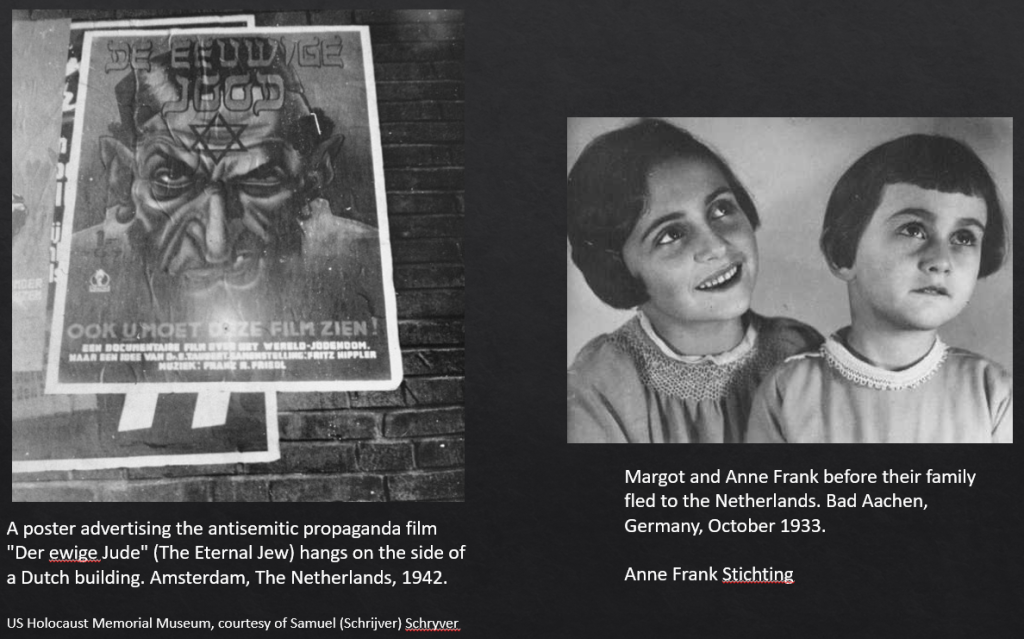 Besides providing perceptions of the enemy, the images also have several internal functions for the group or nation. First, the image of the enemy provides a focal point for group or national loyalty. Secondly, because the images of the enemy are so negative the enemy has less worth and value. The third and most important function of the image of the enemy is to justify the violence needed to overcome the enemy. We have seen where this imagery can lead, as for example in the Nazis’ portrayal of Jews – contrast the abstracted image with the reality.
The alternative image for an enemy presented by Ron Large is “the enemy is human”. This perception carries significant moral weight – seeing the enemy as a fellow being who finds themselves on the same field of battle – and is precisely the reason military training and propaganda have developed alternative images. “If victory is to be achieved, the enemy must be hated to the utmost limit.” *4.
“The enemy must be hated to the utmost limit”. Which stands in stark contrast with another well-known saying of Jesus, “But I say to you who are listening: Love your enemies; do good to those who hate you; bless those who curse you; pray for those who mistreat you.” (from the sermon on the Mount/Plain, Lk 6:27-28; see also Mt 5:43-48, Luke 32-35). In a recent Westar discussion of this, New Testament scholar, Brandon Scott, suggested that “this saying is usually dealt with as an ideal, which quickly defangs it, making it just a nice idea” – unachievable and therefore irrelevant. “Or it is treated as a moral law, in which case it is nonsense” – a roadmap to subjugation. Brandon Scott says “it really functions as an aphorism and is meant “to tease the mind into active thought… It subverts ethics by burlesquing all the fine distinctions ethics tries to make. Who is my enemy? who is my friend? What do I owe them?… It says there is only one response, love, and it makes no distinctions.”
So, what would that response of loving one’s enemy look like? First, as Ron Large suggests, accepting that the enemy is human. Westar’s Executive Director, David Galston, writes that loving enemies “is not equivalent to forgiving and forgetting. Forgiving is a passive act because it involves my internal feelings, and I might reluctantly choose to forgive someone, regardless of the other’s response, simply because I can no longer live with the debilitating resentment anger involves. Loving enemies, by contrast, requires actions. To love an enemy is to act with healing intentions to reconstitute a relationship that was hopelessly lost. The act of loving enemies takes courage, maybe even reckless acts, to overcome an abyss of hate. Loving enemies is not for the faint of heart.” *5
He goes on to write “Being the Samaritan [in the parable] does not mean being the “nice guy”; it means being the one who finds the courage to heal the wounds of enmity that should never have existed.” The acts of loving kindness demanded are those of reconciliation, which requires risk taking, courage, and boldness.
When searching for the psychology of enmity online, I discovered the website of an extraordinary chap called Dr Ofer Zur, author, educator, psychologist and adventurer. He grew up in Israel, the son of European Jews who had lost most of their families in the Holocaust but retained “a fierce dedication” to social justice, compassion and peace. At one time during his compulsory Israeli army service in the 1970s, Dr Zur was based in an overcrowded, poverty-stricken, and polluted refugee camp in the occupied Gaza Strip (yes, fifty years ago!). I would have liked to read to you the whole of his description of an encounter with a Palestinian woman during a routine patrol – it is very powerfully written – but there isn’t time. Here are a few extracts:
“As assigned, I led a squad of eight soldiers on patrol throughout the filthy, narrow alleyways of the camp with no specific mission other than to establish the Israeli army’s presence and affirm its dominance in the camp. We were wandering aimlessly… when I heard a tall young thin Arab woman, fully covered by a burqa, standing on top of a shattered concrete piece, screaming and gesticulating wildly. She held a tiny baby on her hip and had two malnourished, frightened young boys by her side. She yelled and cursed from the bottom of her heart at the heavily armed Israeli soldiers who stood silently and motionlessly beside the huge yellow bulldozer that had just demolished her home.
Not knowing the language, I did not understand most of her yelling and screaming in Arabic, but somewhere I understood each and every word she yelled and spat at us. The second I realized that she was standing on the roof of her own demolished house, I resonated with her rage, fury and despair. I readily imagined what it was like for her to see her house, her shelter, the roof over her babies’ heads, so brutally and definitively flattened by a giant bulldozer – her very life all but erased…her fury evoked my sense of guilt and culpability.” *6
Ultimately, Dr Zur could not reconcile the actions of his country with his personal convictions and left to settle in the USA, studying psychology, psychotherapy and counselling. In 1991, he wrote a paper entitled, “The love of hating: The Psychology of Enmity” *6, which he updated online following the September 11th 2001 terrorist attacks in the US. His work is very much aligned with that which I have described by Professor Ron Large, and the premise for his paper is based on a statement in the UNESCO charter:
“Since wars begin in the minds of men, it is in the minds of men that we have to erect the ramparts of peace.”
Of course, enmity is not confined to international relationships. Our inter-personal relationships can also be subject to the same kind of image building process, in which we dehumanise those who we see as opposed to our interests. Whether it is nameless, faceless, Council employees “wasting our rates” or refusing our “reasonable requests”; the neighbour who annoys us with their loud music and late-night comings and goings who can come to typify in our minds, “feckless youth” or “irresponsible students”; the mass categorisation of “beneficiaries” who are branded with all sorts of social sins by politicians; or awkward relatives or past relationships; we can define them as others and lose a sense of their humanity.
While personal interactions are unlikely to descend to the same level of enmity described for warring nations, the remoteness and anonymity of modern communications, social media and internet chat rooms contribute to a tendency to extremes, as we have seen in the online hatred of Jacinda Ardern expressed during the late stages of the Covid pandemic, or the targeting of academics by David Seymour.
This is where our reading from Paul’s letter to the Galatians can be relevant to us today. Paul was writing for specific circumstances in a specific community, with no conception that his words might be used as a religious text for two millennia, so some faults are probably less applicable than others. The Galatians were originally Celtic tribes who first adopted Hellenistic customs and then enthusiastically accepted Romanisation. The principal religion of Galatia was the cult of the Mother of the Gods, or Mountain Mother, who was a very widespread deity pictured on most Roman coins through Asia Minor (Türkiye) in Paul’s time. According to Wikipedia, the “Mother of the mountain” was originally a fertility figure, associated with the mountain wilds of Asia Minor; she was absorbed and merged into the Greek pantheon of gods from around the 6th Century BC and most Greek rites and processions show her as an essentially foreign, exotic, mystery-goddess who arrives in a lion-drawn chariot to the accompaniment of wild music, wine, and a disorderly, ecstatic following. The Romans adopted her as Cybele, a protector of Rome, around 200BC. There was some conflict between Roman ideas of piety and the cult’s eunuch priests’ flamboyant and effeminate behaviour, so you can imagine the background to Paul’s pious Jewish complaints to the Galatians about self-indulgence.
Many modern Christians also focus on sexual immorality in Paul’s list of “sensual desires”, or “desires of the flesh” or “sinful nature”, as other versions translate it. But Paul summarises the objects of his criticism as “the impulse to be self-serving” and he makes no ranking or distinction between them. “Bitter hostility, violent conflict, jealousy, fits of anger” are equally listed as disqualifications from God’s realm. Paul tells the Galatians the same as the expert in the law says to Jesus before the parable of the good Samaritan: “you are to love your neighbour as yourself”. He concludes this section of his letter by saying, effectively, there are to be no enmities among you, you must treat everyone as your neighbour.
Now there’s an irony in each of these readings, which in fact permeates much of the New Testament. While Paul warns the Galatians against divisiveness and factionalism, he rages against those who were preaching a different message from his own; he warns against bitter hostility but just one verse before today’s reading, Paul wishes that those who were promoting circumcision would castrate themselves (perhaps a dark sense of humour relating to one of the more extreme Cybelian rituals!). When we consider the gospel reading, Luke includes a section of the Q sayings in which Jesus is said to compare the fate of towns which reject his message with the fate of Sodom – and what was that? God rained sulphur and fire out of heaven on Sodom and Gomorrah because of their pride, cruelty and inhospitality!
The Fellows of the Jesus Seminar overwhelmingly agreed in their opinion that these words quoted in Luke were the product of a different tradition, perhaps linked with John the Baptist, and not spoken by Jesus himself. What we see in careful reading of the gospels are multiple layers of writing, accreted onto remembered sayings of Jesus, and what we see from both these and Paul’s letters, is how slow we humans are to learn our lessons. A similar problem can be seen in the gospel of John, in which “the Jews” are demonised and blamed for Jesus’ death. Despite the fact that Jesus and his disciples were themselves Jews, by the final stage of writing, probably 60 years after Jesus’ death, the author of John’s gospel viewed the Jews as a distinct and often hostile group of outsiders. Groups of Jewish Jesus followers would have been driven from Judea after the fall of the Temple on a journey north and west, similar to Paul’s mission journeys. Their experiences of acceptance and rejection along the journey shaped the final versions of the gospels, just as Paul’s experiences shaped his writings. It seems we cannot resist the temptation to define groups of others, to demonise and condemn them. Even when relating Jesus’ instruction to “love one another as I have loved you”, we are seeking to restrict that love, as this cartoon from David Hayward illustrates.
Even when preaching about loving our neighbours, it seems we are defining enemies. And yet love them we must. We must keep on trying to live up to the challenge Jesus issued. As Dr Ofer Zur writes, “We must transform our social and political systems, our communities, workplaces, schools, homes, religious structures and individual psyches by dismantling prejudice, injustice and bigotry.
We must find ways to manage fear, to question forms of self-protection that violate human and civil rights, to refuse to act impulsively with aggression and to bond together in compassion, respect and care of the human family.” *7
References:
*1. Crossan, John Dominic. The Power of Parable: How Fiction by Jesus Became Fiction about Jesus. HarperCollins.
*2. Large, Ron. “Making Enemies” (The Fourth R, 1990, Vol3 #2)
*3. Keen, Sam. “Faces of the Enemy” (Harper and Row, 1986)
*4. Gray, John. “The Warriors” (Harper and Row, 1970)
*5 Galston, David. “Love your Enemies” – Westar Blog, 1 Nov 2023
*6. https://drzur.com/pictorial-biography/part-1/
*7. Zur, Ofer. “The love of hating: The psychology of Enmity.” (History of European Ideas, 13(4), 1991).